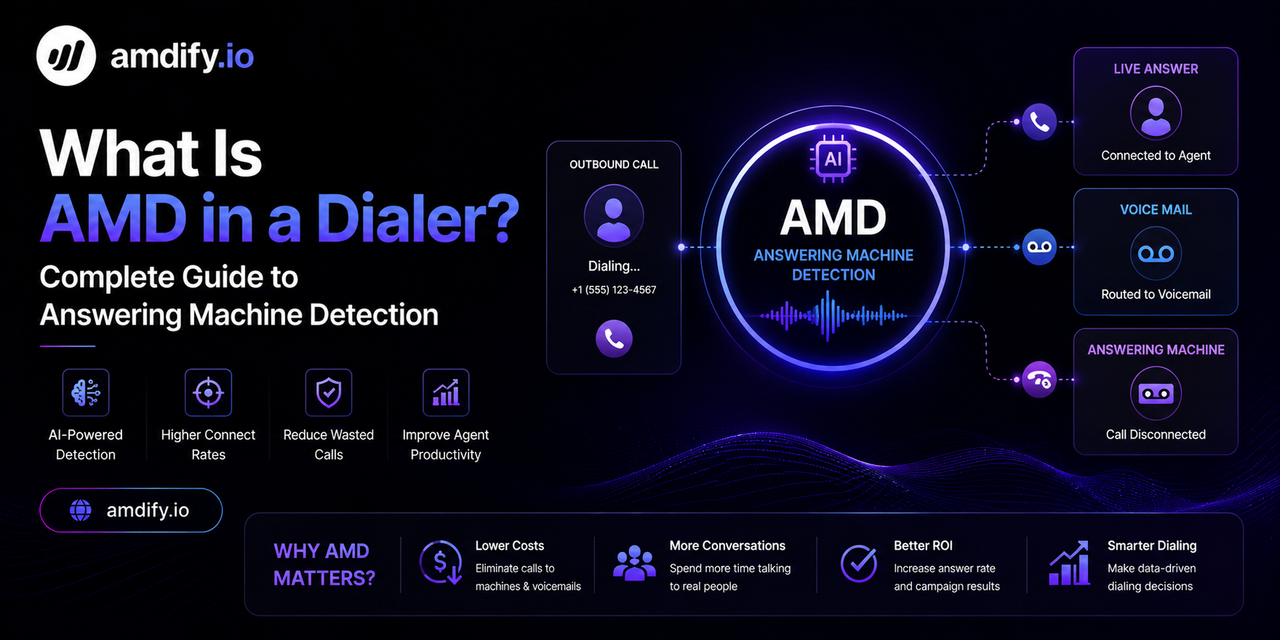
What Is AMD in a Dialer? Complete Guide to Answering Machine Detection
If you run an outbound call center, your dialer makes a split-second decision on every single connected call: is there a live human on the line, or did the call go to voicemail?
That decision is made by AMD — Answering Machine Detection.
AMD is one of the most important and least understood features in outbound dialing. Get it right and your agents spend all their time talking to real people. Get it wrong and you are dropping live customers, wasting agent time on voicemail greetings, and leaving money on the table with every campaign.
This guide explains what AMD is, how it works inside a dialer, why accuracy matters more than most people realize, and what has changed in 2026.
What Does AMD Stand For?
AMD stands for Answering Machine Detection. It is also sometimes called:
- CPA — Call Progress Analysis
- Call Classification
- Voicemail Detection
- Human Detection
All of these terms refer to the same core function: analyzing the audio of a connected call and classifying it as either HUMAN (a live person answered) or MACHINE (an answering machine or voicemail system answered).
The classification happens in real time — typically within the first 1–5 seconds of the call connecting — before any agent is involved.
How AMD Works Inside a Dialer
When your dialer places an outbound call and the call connects, AMD immediately starts analyzing the audio stream. The analysis looks for patterns that distinguish human speech from recorded greetings.
Traditional Rule-Based AMD
Most dialers — including VICIdial and systems running on Asterisk — use a rules-based approach:
Silence detection: The length of silence at the start of a call. Voicemail systems often have a brief processing pause before the greeting plays. Humans usually say something immediately.
Word burst analysis: How long someone speaks before pausing. Voicemail greetings tend to be one continuous speech segment: "Hi, you've reached John Smith, please leave a message after the tone." Humans typically say a short greeting and wait for a response.
Greeting length: Measured in milliseconds. Most voicemail greetings are longer than a typical human answer.
Beep detection: A tone following extended speech is a strong indicator that the call reached voicemail.
These rules are configured through parameters — in Asterisk's AMD system, they live in a file called amd.conf.
AI-Powered AMD
Newer AMD solutions use machine learning models trained on millions of classified call recordings. Instead of checking predefined thresholds, the model analyzes the full acoustic signature of the greeting — speech patterns, rhythm, background noise, carrier processing artifacts — and outputs a classification with a confidence score.
AI-powered AMD is significantly more accurate because it can handle the variability that breaks rules-based systems: short human responses, iOS voicemail behavior, international carriers, and VoIP audio processing.
Why AMD Matters for Your Call Center
AMD directly controls what happens after a call connects:
- HUMAN classification → call is routed to an available agent
- MACHINE classification → call is routed to your voicemail handling logic (leave a message, hang up, or log and retry)
The accuracy of that classification has a direct financial impact.
The Cost of False Positives
A false positive in AMD means a live human was classified as a machine. The call connected, a real person answered, but your dialer hung up on them before they reached an agent.
With traditional dialers running default settings, false positive rates of 15–25% are common. That means 1 in 4 of your connected live calls never reaches an agent.
On a campaign running 10,000 dials per day with a 12% connect rate:
- 1,200 calls connect to live humans
- At 20% false positive rate: 240 live humans get hung up on per day
- At an average value of $40 per live conversation: $9,600 lost per day
See the full breakdown in our VICIdial false positive rate guide.
The Cost of False Negatives
A false negative means a voicemail was classified as a human. Your agent gets connected to a voicemail greeting, has to manually recognize it, and hangs up — wasting 10–20 seconds of agent time and disrupting their rhythm.
Both errors cost money. False positives are usually the larger problem because they represent real lost revenue.
AMD in VICIdial and Asterisk
VICIdial is the most widely used open-source outbound dialer in the world. It runs on Asterisk, which includes a built-in AMD application.
VICIdial's AMD can be configured in the admin panel under Campaign settings. The key options are:
- AMD enabled/disabled: Turn AMD on or off per campaign
- AMD timeout: How long AMD will analyze before giving up
- AMD action: What to do with MACHINE-classified calls
Under the hood, these settings control the parameters passed to Asterisk's AMD() dialplan application.
The default parameters work adequately for basic use cases but produce high false positive rates in modern calling environments. See the Asterisk vs AI-powered AMD comparison for a detailed accuracy breakdown.
AMD in Other Dialer Platforms
Most major dialer platforms include AMD or call progress analysis:
| Platform | AMD Approach |
|---|---|
| VICIdial / Asterisk | Built-in rule-based AMD application |
| Five9 | Proprietary CPA engine |
| NICE inContact | Integrated call classification |
| Genesys | Built-in AMD with configurable thresholds |
| Twilio | Async answering machine detection via API |
| Custom Asterisk | Asterisk AMD or third-party API |
All of these use the same fundamental approach: analyze the first few seconds of audio and classify. The differences are in accuracy, latency, and configurability.
What Has Changed About AMD in 2026
Several developments have made accurate AMD harder — and more important — in 2026:
iOS 26 Voicemail Changes
Apple's iOS 26 updated the default voicemail system, changing the acoustic characteristics of voicemail greetings. Traditional AMD systems that were calibrated against older iOS voicemail behavior now misclassify a meaningful percentage of iOS voicemails.
Carrier Audio Processing
Modern VoIP carriers apply more aggressive audio processing — noise reduction, echo cancellation, level normalization — than they did five years ago. This processing changes the acoustic properties of both human and machine audio in ways that confuse threshold-based detection.
Short Mobile Responses
As more calls are answered on mobile devices, short responses like a quick "Hello?" in under 300ms have become more common. These short responses look like machine behavior to rules that were calibrated for longer human greetings.
International Calling Growth
Many contact centers have expanded to international calling. Voicemail greeting formats, language patterns, and carrier behavior differ significantly by country — creating accuracy problems for systems calibrated on US domestic traffic.
How to Choose an AMD Solution
When evaluating AMD for your dialer, the key criteria are:
Accuracy: Specifically false positive rate (live humans dropped) and false negative rate (voicemails reaching agents). Ask for data on both — not just overall accuracy.
Latency: How quickly does the system return a classification? Faster classification means agents get connected sooner and abandonment rates stay lower.
Fail-safe behavior: If the AMD system errors out, what happens? A well-designed system defaults to HUMAN — better to send a voicemail to an agent than to drop a live call.
Integration: How does it connect to your dialer? For VICIdial and Asterisk, look for systems that provide an AGI script or native dialplan integration.
Ongoing tuning requirements: Rules-based systems require continuous manual tuning as call patterns change. AI-powered systems handle variation automatically.
amdify.io is designed specifically for VICIdial and Asterisk environments — it replaces the built-in AMD decision with AI-powered classification while keeping the rest of your dialing stack unchanged.
Summary
AMD (Answering Machine Detection) is the technology that classifies every connected call as HUMAN or MACHINE before routing it to an agent or voicemail handler.
Key points:
- Traditional AMD uses audio rules — silence duration, word burst length, beep detection
- AI-powered AMD uses neural models trained on millions of recordings
- False positive rate (live humans dropped) is the metric that most directly affects revenue
- Default Asterisk AMD parameters produce 15–25% false positive rates in modern environments
- AI-powered AMD reduces false positives to 1–3%
- The accuracy gap has widened in 2026 due to iOS 26 changes and carrier audio processing
If you are running outbound campaigns and have not measured your AMD false positive rate, that is the first thing to do. A 20-minute manual audit of 200 MACHINE-classified recordings will tell you exactly how much revenue you are leaving on the table.