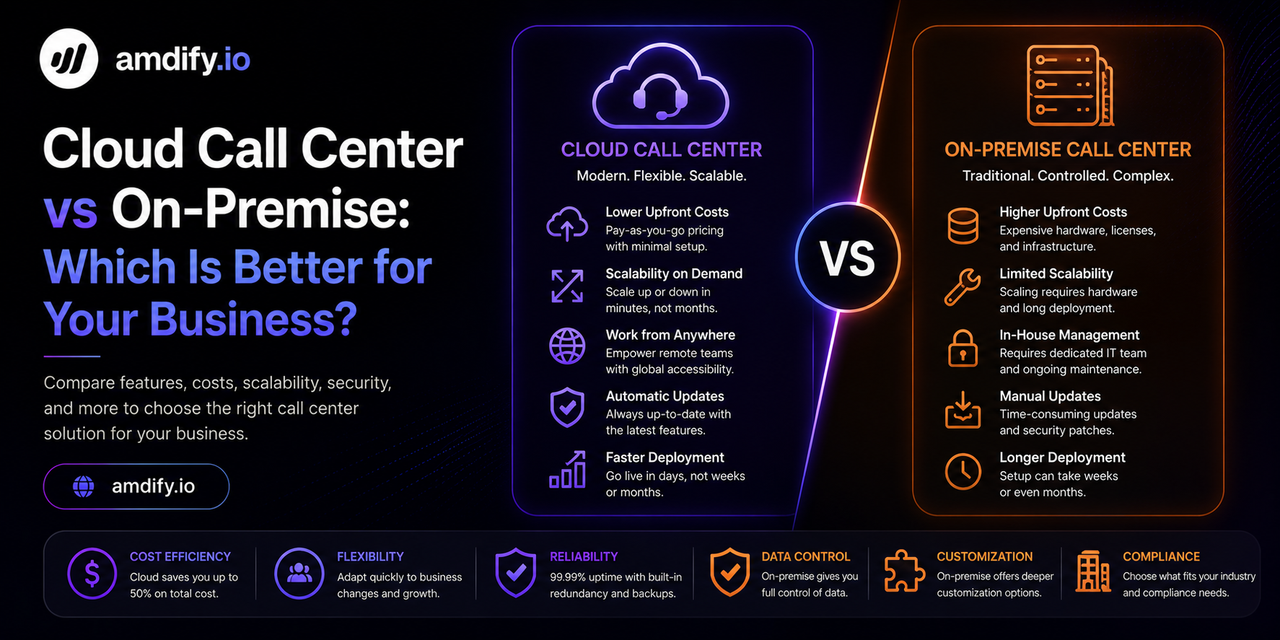
Cloud Call Center vs On-Premise: Which Is Better for Your Business?
When setting up a call center, one of the first major decisions is where your software lives: in the cloud (on someone else's servers) or on-premise (on servers you manage yourself).
Both approaches are used by successful call centers around the world. The right choice depends on your team size, technical capability, budget structure, compliance requirements, and growth plans.
This guide breaks down the real differences — not the marketing version — so you can make the right choice for your specific situation.
What Is a Cloud Call Center?
A cloud call center runs its software on servers managed by a third-party provider. You access the system through a web browser or app. The provider handles all infrastructure — servers, maintenance, updates, backups, and uptime.
Examples: Five9, RingCentral Contact Center, NICE inContact, Genesys Cloud, Twilio Flex.
You pay a monthly subscription — typically per agent per month. No servers to buy, no IT team required to maintain infrastructure.
What Is an On-Premise Call Center?
An on-premise call center runs its software on servers you own and manage — either physically in your office or in a data center you rent. You are responsible for all infrastructure: installation, maintenance, updates, backups, and uptime.
The most widely used on-premise call center platform globally is VICIdial — a free, open-source system built on Asterisk. It powers call centers across Pakistan, India, Philippines, Egypt, and beyond because the software is free and highly customizable.
You pay for hardware (or a VPS) and the technical expertise to manage it — but not a per-seat software subscription.
Cost Comparison
This is where the decision often starts — and where many buyers get misled by incomplete comparisons.
Cloud Call Center Costs
| Cost Item | Typical Range |
|---|---|
| Software subscription | $80–200 per agent per month |
| SIP trunking (usually separate) | $0.01–0.05 per minute |
| Internet connection | $50–500/month |
| Agent hardware (headsets, computers) | One-time cost |
| IT support | Minimal |
For a 20-agent cloud call center: $1,600–4,000/month in software alone, plus carrier costs.
On-Premise Call Center Costs (VICIdial)
| Cost Item | Typical Range |
|---|---|
| Software (VICIdial) | Free |
| Cloud server / VPS | $80–300/month |
| SIP trunking | $0.005–0.03 per minute |
| Internet connection | $50–500/month |
| IT / system admin | $200–1,000/month |
| Agent hardware | One-time cost |
For a 20-agent VICIdial setup: $400–1,500/month total infrastructure, plus carrier costs.
Total Cost at Scale
| Team Size | Cloud (annual) | On-Premise (annual) | Savings with On-Premise |
|---|---|---|---|
| 10 agents | $9,600–24,000 | $4,800–10,000 | 40–60% |
| 25 agents | $24,000–60,000 | $6,000–15,000 | 60–80% |
| 50 agents | $48,000–120,000 | $8,000–20,000 | 70–85% |
| 100 agents | $96,000–240,000 | $12,000–30,000 | 80–90% |
On-premise wins on cost at almost every scale — especially for operations in Pakistan, India, and Philippines where IT talent is available and server costs are low.
Setup Speed
Cloud: Sign up, configure, agents log in. Operational in hours. No infrastructure decisions.
On-premise: Install Linux, install Asterisk, install VICIdial, configure SIP trunks, configure networking, harden security. Takes 1–5 days with experience. Longer for first-timers.
Winner: Cloud — by a large margin for speed of initial setup.
Scalability
Cloud: Add a new agent seat in minutes — just create an account and the agent logs in. No infrastructure changes.
On-premise: Adding agents requires verifying your server has enough capacity (CPU, RAM), possibly upgrading your VPS plan, and configuring new agent accounts. Still fast — usually under an hour — but requires a technical resource.
Winner: Cloud for instant scaling. On-premise with a competent admin is nearly as fast in practice.
Control and Customization
Cloud: You control what the provider lets you control. You cannot access the underlying server, modify the core code, or integrate with systems the provider does not support. Updates happen on the provider's schedule.
On-premise: Full control. You can modify dialplan logic, integrate with any system via API or direct database access, control exactly when updates are applied, and build custom features. VICIdial's code is open source — you can change anything.
Winner: On-premise — significant advantage for operations with specific technical requirements.
Reliability and Uptime
Cloud: Enterprise providers offer 99.9–99.99% uptime SLAs. Redundancy is built into their infrastructure. You are dependent on their reliability — but it is usually very high.
On-premise: Reliability depends entirely on your infrastructure and technical team. A poorly managed VPS can have more downtime than any cloud provider. A well-managed setup with redundant SIP trunks and automated failover can match cloud reliability.
Winner: Cloud for teams without strong technical infrastructure. On-premise wins for teams that invest in proper redundancy.
Data Security and Compliance
Cloud: Your call data — recordings, customer information, call logs — lives on the provider's servers. You must trust their security practices. For some regulated industries (financial services, healthcare), this creates compliance questions.
On-premise: Your data stays on your servers. You control access, encryption, retention policies, and audit logs entirely. For compliance-sensitive operations, this is a significant advantage.
Winner: On-premise for data sovereignty and compliance-sensitive industries.
Technical Requirement
Cloud: Minimal. You need someone who can configure settings in a web admin panel. No Linux, no Asterisk, no networking expertise required.
On-premise: Requires Linux administration, Asterisk/VICIdial knowledge, networking and firewall configuration, and ongoing system maintenance. This is a real requirement — not optional.
Winner: Cloud for teams without technical resources. On-premise for teams with or willing to hire a system administrator.
AMD (Answering Machine Detection) Comparison
Both approaches support AMD, but with important differences:
Cloud dialers: AMD is built into the platform. You typically have limited control over AMD parameters — it works as configured by the provider. Accuracy varies by platform.
On-premise (VICIdial/Asterisk): Full control over AMD parameters. You can tune aggressively or replace the entire AMD engine with a third-party solution like amdify.io, which reduces false positive rates from 15–25% to 1–3%.
For operations where AMD accuracy directly impacts revenue — which is every outbound call center — on-premise gives you more control to optimize it.
Side-by-Side Summary
| Factor | Cloud | On-Premise (VICIdial) |
|---|---|---|
| Setup speed | Hours | 1–5 days |
| Monthly cost | Higher | Lower |
| Technical skill needed | Low | Medium–High |
| Customization | Limited | Full |
| Scalability | Instant | Fast with admin |
| Data control | Provider's servers | Your servers |
| AMD control | Limited | Full |
| Uptime (managed well) | Very high | High |
| Best for | Quick start, small teams | Cost efficiency, control |
Who Should Choose Cloud?
- You need to launch in days, not weeks
- Your team has no Linux or VoIP technical expertise
- You have fewer than 10 agents and the per-seat cost is manageable
- Your industry requires certifications your cloud provider holds (PCI DSS, HIPAA, etc.)
- You want someone else responsible for uptime and maintenance
Who Should Choose On-Premise (VICIdial)?
- You have 10+ agents and cost efficiency matters
- You are in Pakistan, India, Philippines, or Egypt where IT resources are available and affordable
- You need full control over your data and call recordings
- You want to customize your dialing logic, AMD settings, or integrations
- You have or can hire someone with Linux/VoIP experience
- You are running a BPO or high-volume outbound operation
The Hybrid Approach
Many growing call centers start with a cloud dialer for speed, then migrate to on-premise VICIdial once they have proven their campaign economics and hired technical resources.
This is a valid path — cloud first to learn the business, on-premise once you know what you need and have the team to run it.
Getting Started
Cloud path: Choose a provider (Five9, RingCentral, Twilio Flex), sign up, configure campaigns, and launch. Most providers have free trials.
On-premise path: See the VICIdial setup guide for beginners for step-by-step installation, and the complete call center setup guide for the full infrastructure picture.