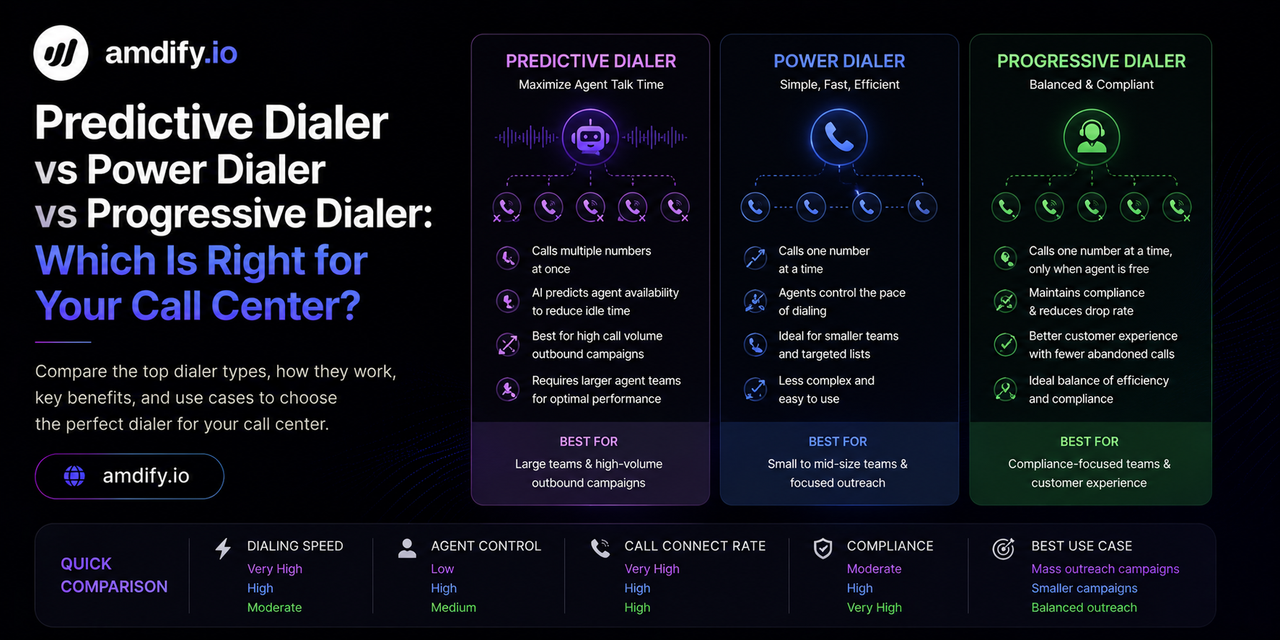
Predictive Dialer vs Power Dialer vs Progressive Dialer: Which Is Right for Your Call Center?
If you run an outbound call center, your dialer is the engine of your entire operation. Choose the wrong type and your agents sit idle, your abandon rate spikes, or your compliance risk goes through the roof.
The three most common types — predictive, power, and progressive — each solve the same problem in fundamentally different ways. Understanding the difference is one of the most important decisions you make when setting up or scaling an outbound operation.
This guide explains exactly how each type works, where each performs best, and how to choose the right one for your specific situation.
What All Three Dialers Have in Common
All three dialer types automate outbound calling. Instead of an agent manually dialing each number, the dialer places calls automatically and connects the agent only when a live human answers.
All three use AMD (Answering Machine Detection) to classify connected calls as HUMAN or MACHINE. A HUMAN classification routes the call to an agent. A MACHINE classification routes to your voicemail handling logic.
The key difference between the three types is how aggressively they dial — specifically, how many calls they place per available agent and when.
Predictive Dialer
How It Works
A predictive dialer uses an algorithm to forecast when agents will become available and places multiple calls simultaneously — before any agent is free.
The algorithm considers:
- Current agent availability and average handle time
- Historical answer rates for the list being dialed
- Current connect rate and AMD classification speed
- Regulatory abandon rate limits (3% under FTC rules)
The goal is to have a live call waiting the instant an agent finishes their current call — minimizing idle time between conversations.
The Numbers
On a predictive dialer, the system might place 3–5 calls for every available agent, knowing that most will go to voicemail or ring-no-answer. When more calls connect simultaneously than there are available agents, the excess calls are dropped — these are called "abandoned calls."
The FTC requires that abandoned calls not exceed 3% of all connected calls over a 30-day period.
Where Predictive Dialers Win
- High-volume B2C campaigns with large lists and moderate connect rates
- Collections and debt recovery where volume is the primary driver
- Insurance and financial services outreach at scale
- Operations where agent utilization is the top priority
Where Predictive Dialers Struggle
- Low-volume or small-list campaigns — the algorithm needs volume to work accurately
- High-value B2B calling — abandoned calls damage relationships
- Compliance-sensitive operations — the abandon rate limit creates ongoing risk
- Operations with high AMD false positive rates — dropped live calls count as abandons
AMD Accuracy Is Critical for Predictive Dialers
This is the most important point most predictive dialer users miss: your AMD accuracy directly affects your abandon rate compliance.
When a live call is misclassified as MACHINE (a false positive), it is dropped. Depending on how your dialer counts dispositions, this can register as an abandoned call — pushing you toward the 3% regulatory limit. Operations with 15–20% AMD false positive rates on predictive campaigns are often unknowingly running close to or over the compliance line.
See what AMD is and how it works for the full breakdown.
Power Dialer
How It Works
A power dialer places one call per available agent — but it dials automatically as soon as the agent becomes free, without waiting for the agent to manually dial.
There is no predictive algorithm, no multiple simultaneous calls, and no abandoned calls. The agent is always ready when the call connects.
Where Power Dialers Win
- B2B sales where every contact is valuable and abandoned calls are unacceptable
- Small teams where predictive algorithms cannot work accurately
- High-value lists where relationship quality matters more than volume
- Compliance-first operations that cannot risk abandoned call violations
- Operations where call quality matters more than raw throughput
Where Power Dialers Struggle
- Very large lists where you need to maximize dials per hour
- Low connect rate campaigns — agents spend more time waiting between live connections
- Operations where agent utilization is the dominant concern
Power Dialer Performance
Power dialers typically achieve 40–60 dials per agent per hour compared to 80–120 for predictive dialers on the same list. The tradeoff is zero abandoned calls and higher conversation quality.
Progressive Dialer
How It Works
A progressive dialer is a middle ground between power and predictive. It dials automatically (like a power dialer) but may place a small number of calls slightly ahead of agent availability — typically 1.5–2x rather than the 3–5x of a full predictive system.
The ratio is configurable and conservative enough to keep abandon rates well below the regulatory limit while still reducing agent idle time compared to a strict power dialer.
Where Progressive Dialers Win
- Operations that want more throughput than a power dialer but cannot risk the abandon rate exposure of full predictive
- Mid-size teams (5–20 agents) where predictive algorithms are unreliable but pure power dialing is too slow
- Mixed campaigns — some lists are high volume, others are high value
Side-by-Side Comparison
| Feature | Predictive | Power | Progressive |
|---|---|---|---|
| Dials per agent/hour | 80–120 | 40–60 | 60–80 |
| Abandoned calls | Yes (up to 3%) | None | Minimal |
| Compliance risk | Higher | Lowest | Low |
| Best team size | 10+ agents | Any size | 5–20 agents |
| Best for | B2C volume | B2B quality | Mixed |
| Agent idle time | Lowest | Higher | Medium |
| AMD dependency | Critical | Important | Important |
| Setup complexity | Higher | Simple | Medium |
Which Dialer Is Right for Your Operation?
Choose Predictive If:
- You have 10+ agents running simultaneously
- Your list has 100,000+ records
- Your campaign is B2C (insurance, collections, political, surveys)
- Maximizing dials per hour is your primary goal
- You have high-accuracy AMD in place
Choose Power If:
- You run B2B campaigns where every lead is valuable
- Your team is fewer than 10 agents
- You cannot risk abandoned call compliance issues
- Call quality and agent preparation matter more than throughput
- You are calling decision-makers who will not tolerate being dropped
Choose Progressive If:
- You want more throughput than power but safer than predictive
- Your team size fluctuates and the predictive algorithm becomes unreliable
- You run a mix of campaign types
The Role of AMD in All Three Dialer Types
Regardless of which dialer type you use, AMD accuracy determines how many live conversations your agents actually have.
- Predictive: AMD false positives count as abandoned calls, creating compliance risk
- Power: AMD false positives waste the one call the agent was waiting for
- Progressive: AMD false positives reduce the efficiency gain over pure power dialing
Default Asterisk/VICIdial AMD settings produce 15–25% false positive rates — meaning 1 in 5 connected live humans never reaches an agent. This problem exists regardless of dialer type.
amdify.io reduces false positives to 1–3% across all three dialer modes, recovering live conversations that default AMD is silently dropping.
VICIdial Dialer Mode Settings
If you run VICIdial, the dialer type is controlled per-campaign:
- RATIO mode → Power dialer behavior (1:1 ratio)
- ADAPT_HARD_LIMIT → Predictive with hard 3% abandon ceiling
- ADAPT_TAPERED → Predictive that eases off as abandon rate approaches limit
- ADAPT_AVERAGE → Standard predictive
- INBOUND_MAN → Manual / inbound handling
For most outbound B2C campaigns in VICIdial, ADAPT_HARD_LIMIT is the recommended predictive mode because it automatically stays within the FTC 3% limit.
Final Thoughts
Predictive, power, and progressive dialers are not competing products — they are different tools for different jobs. The right choice depends on your list size, team size, campaign type, and compliance priorities.
What all three have in common is that AMD accuracy directly determines how many live conversations actually reach your agents. Improving AMD accuracy is the one optimization that makes all three dialer types more effective simultaneously.