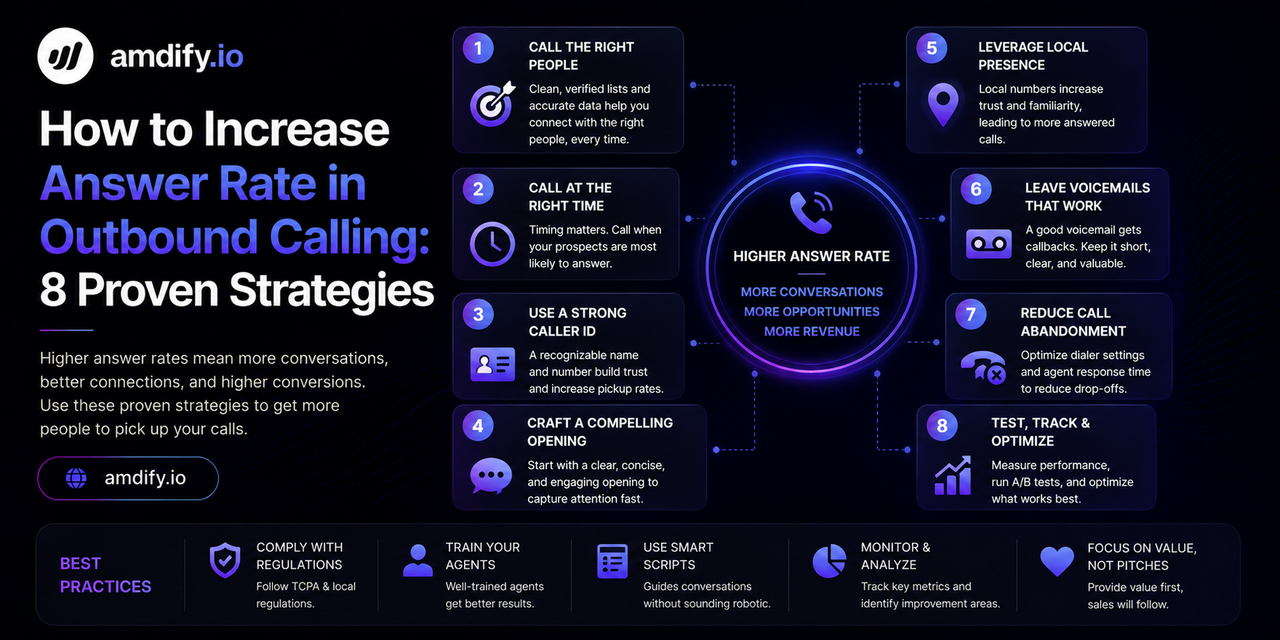
How to Increase Answer Rate in Outbound Calling: 8 Proven Strategies
Answer rate is the percentage of your outbound dials that result in someone actually picking up the phone. It is the first number in your entire campaign math — and if it is low, everything else suffers.
A campaign that converts 30% of answered calls but only gets a 6% answer rate produces the same results as a campaign that converts 15% but gets a 12% answer rate. The math is identical. Which means doubling your answer rate is equivalent to doubling your conversion rate — often a much easier problem to solve.
Here are 8 specific strategies that move answer rate, in order of typical impact.
Strategy 1: Fix Your Caller ID Reputation
This is the single biggest lever for most operations in 2026 — and the one most call centers have never checked.
Mobile carriers and third-party apps (Hiya, First Orion, Nomorobo) now label outbound numbers as "Spam Likely", "Scam Risk", or "Telemarketer" based on complaint data and call behavior patterns. When a flagged number calls, the recipient sees the warning label before deciding whether to answer.
The impact is severe: a flagged number sees answer rates drop 40–70% compared to a clean number with the same caller ID.
How Numbers Get Flagged
- High daily call volume from a single number
- High ratio of short-duration calls (voicemails, ring-no-answer)
- Consumer complaints filed through carrier portals
- Calling patterns that resemble robocall behavior
How to Fix It
- Check your numbers — use TNS Call Guardian, Hiya for Business, or First Orion to see how your numbers appear on recipient screens
- Rotate numbers — spread your dial volume across more numbers to reduce per-number flagging risk
- Register your numbers — Free Caller Registry (freecallerregistry.com) lets you register your business identity with major carriers
- File remediation requests — if a number is already flagged, you can request removal through most carrier portals
- Use local presence numbers — numbers with area codes matching the recipient's region answer better than out-of-state numbers
Strategy 2: Call at the Right Time
Timing has a larger impact on answer rate than most call centers realize — and the effect is invisible in aggregate reporting.
Best Times to Call
| Day / Time | Answer Rate Index |
|---|---|
| Tuesday–Thursday, 10–11:30am local | Highest |
| Tuesday–Thursday, 4–6pm local | High |
| Wednesday, any time | Above average |
| Monday morning | Below average |
| Friday afternoon | Low |
| Lunch hour (12–1:30pm) | Low |
| Weekends (B2B) | Very low |
| Weekends (B2C financial) | Above average |
Implementation
- Segment your list by time zone
- Schedule dial batches to run during high-answer windows
- Do not dial your full list continuously — front-load calls to the best time windows
- Test your specific demographic — the above are averages; your list may differ
Strategy 3: Improve AMD Accuracy
This is the most overlooked answer rate problem — because it looks like a different problem entirely.
When AMD (Answering Machine Detection) classifies a live human as a voicemail, the call is dropped before it reaches an agent. In your reporting, it shows as a MACHINE disposition. Your answer rate metric shows it as a non-answer.
But the phone was answered. The answer rate problem is actually an AMD problem in disguise.
With default Asterisk/VICIdial AMD settings, 15–25% of connected live calls are misclassified and dropped. On a campaign with a true 12% human answer rate, this means your reported answer rate is closer to 9–10% — not because people are not answering, but because your AMD is dropping them.
Fixing AMD accuracy is one of the fastest ways to improve apparent answer rate without changing anything about your list or timing.
See VICIdial false positive rate: why your AMD is dropping live calls for the full measurement and fix guide.
amdify.io reduces AMD false positives to 1–3%, recovering the live calls that default AMD silently drops.
Strategy 4: Clean and Segment Your List
Calling disconnected, reassigned, or wrong-party numbers wastes dial capacity and damages your caller ID reputation. List quality directly affects answer rate.
List Cleaning Steps
Disconnect scrubbing: Run your list through a carrier lookup before each campaign. Remove numbers that are disconnected. Services like Twilio Lookup, Neustar, or Melissa Data provide this at low cost per query.
Reassignment scrubbing: Numbers change hands. The FCC's Reassigned Numbers Database (RND) lets you verify a number has not been reassigned since you obtained consent.
DNC scrubbing: Remove numbers on the National Do Not Call Registry. Required by law, but also removes contacts who will never answer a sales call.
Recency segmentation: Recent leads answer at higher rates than aged leads. Segment your list by lead age and dial recent leads during your best time windows.
How List Decay Affects Answer Rate
Phone lists decay at roughly 15–20% per year. A list that was clean 12 months ago has meaningful degradation. Dialing a 30% stale list means nearly 1 in 3 dials goes to a disconnected or reassigned number — driving down answer rate and increasing caller ID flagging risk simultaneously.
Strategy 5: Use Local Presence Calling
Recipients are significantly more likely to answer calls from numbers with familiar area codes.
Local presence means displaying a caller ID number with the same area code as the person you are calling — even if your call center is in a different city or country.
Studies consistently show local presence improves answer rates by 20–40% compared to out-of-state or toll-free numbers.
Implementation
- Acquire local DID numbers in your target geographies
- Configure your dialer to display the local number for calls to each region
- This requires a pool of local numbers — typically one number per 200–500 daily dials to avoid per-number flagging
Strategy 6: Optimize Your Voicemail Strategy
Voicemail affects future answer rates. A well-crafted voicemail increases the probability the contact will answer your next call. A bad voicemail increases the probability they will decline all future calls.
Effective Voicemail Principles
- Keep it under 25 seconds — longer voicemails are deleted immediately
- State who you are and why you are calling — vague voicemails are ignored
- One specific reason to call back — not a pitch, just a hook
- No pressure language — urgency in a voicemail reads as scam
- Leave voicemail only on attempt 1 and attempt 4 — repeated voicemails increase complaint rate and flagging risk
Pre-recorded Voicemail Drops
Pre-recorded voicemail drops (RVMs) let agents leave a consistent voicemail without waiting through the greeting. This saves 20–40 seconds of agent time per voicemail. Note: RVMs have their own compliance requirements — verify your use case is covered before deploying.
Strategy 7: Speed to Dial on Fresh Leads
For operations working inbound lead flow, speed to first dial is the highest-leverage answer rate variable of all.
Research consistently shows:
- Dialing within 5 minutes of lead submission: contact rates of 30–50%
- Dialing after 30 minutes: contact rates drop by 50–70%
- Dialing the next day: contact rates below 10%
The person just raised their hand — they are thinking about your product right now. Wait an hour and they have moved on.
Implementation
- Configure your CRM to push new leads to your dialer immediately
- Set up a priority queue for fresh leads that bypasses the regular campaign list
- Alert agents when a high-priority fresh lead enters the queue
Strategy 8: A/B Test Your Caller ID Display Name
Most carriers now support STIR/SHAKEN attestation and branded calling, which lets you display a business name alongside your number on the recipient's screen.
Displaying your company name instead of just a number — or displaying a local business name rather than an unfamiliar corporate name — can meaningfully improve answer rates.
Test variations:
- Company name vs. no name
- Full company name vs. shortened version
- Local office name vs. corporate name
Run each variant for at least 500 dials before comparing results.
The Combined Impact
Implementing multiple strategies compounds:
| Starting Answer Rate | After Strategies | Improvement |
|---|---|---|
| 6% (flagged numbers, default AMD, stale list) | Baseline | — |
| After caller ID fix | ~9% | +50% |
| After AMD accuracy fix | ~11% | +83% |
| After list cleaning + timing | ~14% | +133% |
| After local presence | ~17% | +183% |
These are directional estimates — actual results vary by industry, list quality, and market. But the compounding effect is real: fixing multiple variables simultaneously produces results larger than any single fix.
Where to Start
If you are choosing one thing to fix first:
- Check your caller ID reputation — takes 10 minutes, shows you whether flagging is the problem
- Audit your AMD false positive rate — pull 200 MACHINE-classified recordings and count human voices
- Check your list age — if more than 20% of your list is older than 90 days, clean it before dialing
These three diagnostics will tell you where your answer rate is actually leaking and which fix will have the biggest impact for your specific operation.